The gate opensat eleven. Preparationbegins at nine.
End-to-end coaching for India's most selective schools — RIMC, RMS, UP Sainik School, Gurukul Kurukshetra, and top boarding schools with WEDA. The written paper. The viva board. GK and fitness. Taught by officers who sat on the other side of the table.
Scroll to exploreClass IV to Class IX entry pointsOnline · Offline in Dehradun · On the Samvad app
·
Who this is for
Five gates. Each with a different lock.
Parents speak of "the Sainik School exam" as if it were one paper. It is not. Five institutions. Five entry ages. Five different ideas of the child they want. Here is what each one actually tests.
— i
Rashtriya Military School (RMS)
Five campuses — Chail, Ajmer, Belgaum, Bengaluru, Dholpur — run by the Ministry of Defence. Now open to girls. Entry at Class VI and Class IX, through the Common Entrance Test, an interview and a full medical. The paper rewards speed over brilliance. Children who miss out here lose on the clock — not the syllabus.
— ii
Rashtriya Indian Military College (RIMC)
Founded 1922. The oldest feeder to the NDA — and the hardest school entrance in India. Twenty-five cadets a term. Class VIII entry only, ages 11½–13. English 125. Maths 200. GK 75. And a 50-mark viva that decides more selections than parents expect. The board isn't testing what a twelve-year-old knows. It's testing whether he can hold a thought — steadily — in front of three strangers in uniform.
— iii
UP Sainik School, Lucknow
State-run, UP domicile only. Entry at Class VI and IX; a girls' wing since 2018. Because seats are state-limited, the cut-off behaves differently: an even score everywhere beats one strong subject carrying the rest.
— iv
Gurukul Kurukshetra
Sanskrit, yoga and discipline beside a full modern curriculum — feeding the forces and the civil services. Entry from Class VI. The paper tests Maths, language, reasoning. The interaction tests one thing: can this child live a structured, screen-free life away from home — and want to?
— v
Top Boarding Schools of India · with WEDA
Doon. Welham. Mayo. Scindia. Sanawar. Bishop Cotton. Entry from Class IV to IX — each school with its own paper and its own idea of fit. We run the whole campaign, including the part nobody prepares for: the parent interview.
— vi
Not sure which gate?
Different children clear different boards. One diagnostic, and you'll know which two schools deserve your next eighteen months — and which don't.
This is not a video library with a login. Every part below exists because a real child lost a real seat without it.
Recorded Courses
120+ lessons for RIMC and RMS, sequenced as the syllabus is examined. Each ends in a timed worksheet. Access runs the full attempt cycle — slip a term, and you don't restart from zero.
The Handbooks
RIMC, RMS, fitness and GK — authored in-house, in print and on the app. Not question dumps. Teaching books — by people who cleared these selections, then conducted them.
Mock Interviews
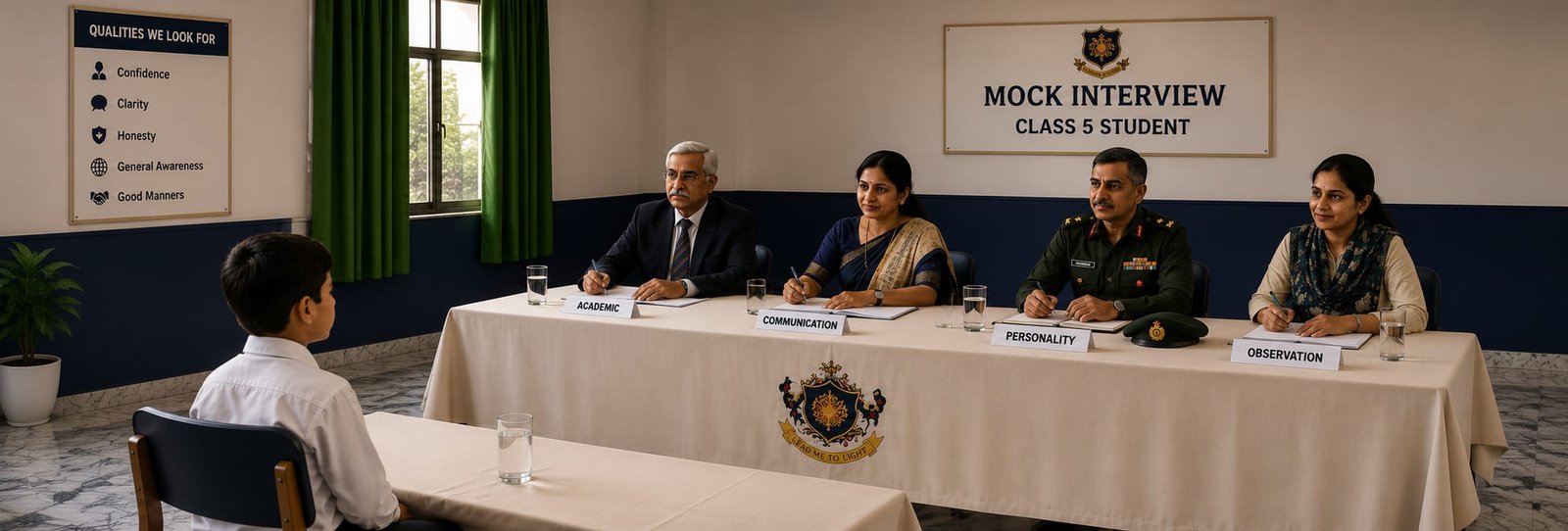
A real board, not a friendly chat — retired officers, a table, your child's own file, twenty minutes of graded questioning. Recorded, scored and returned to you: bearing, clarity, awareness, honesty.
Offline Preparation, Dehradun
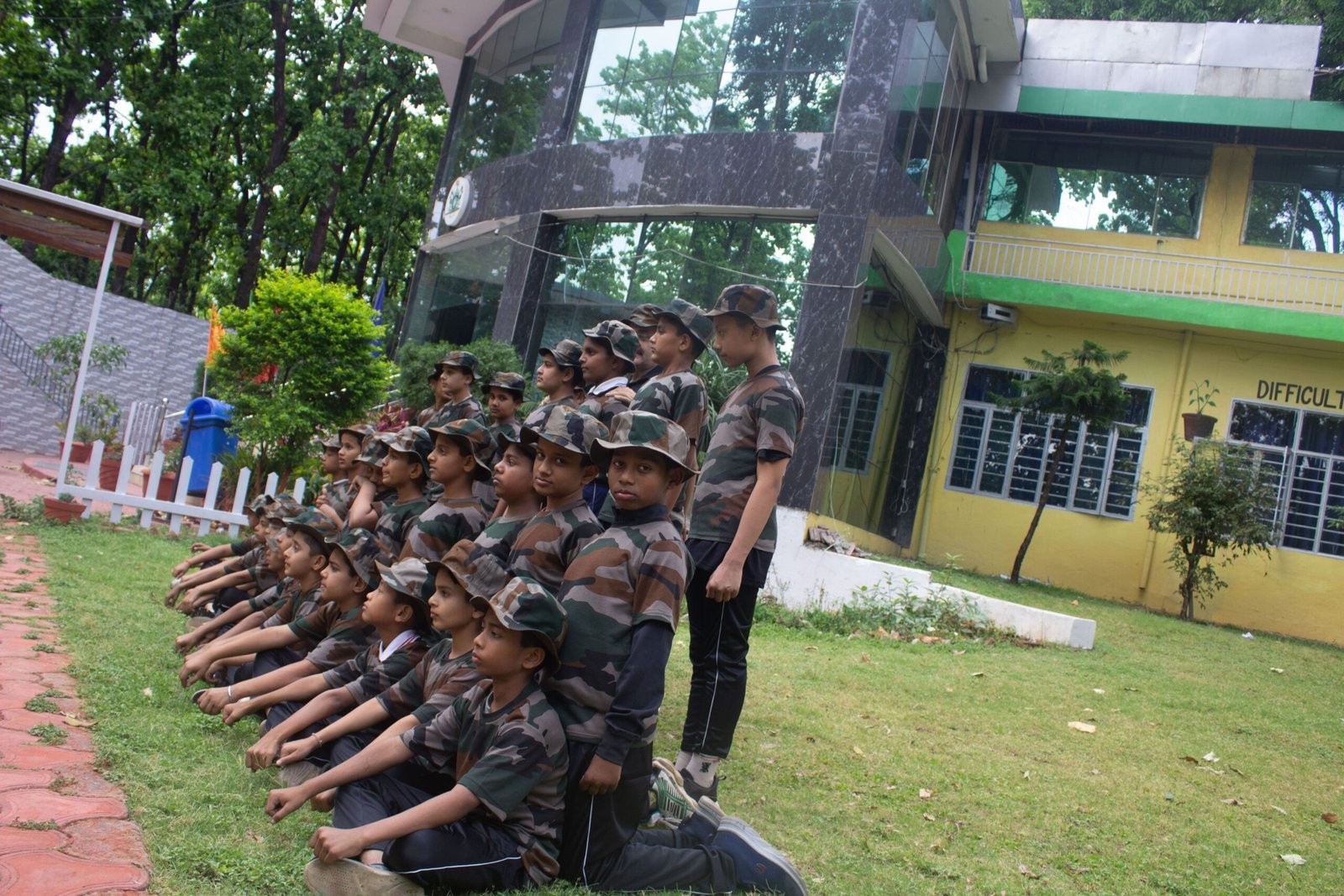
In-person coaching, minutes from RIMC's own gates. Twelve students, three sessions a week, weekend board simulations. Outstation families: a ten-day residential sprint before each exam window.
Online Classes
Live evening classes, six a week, capped at twenty — so every child speaks in every session. Maths and English on weekdays. GK on Saturday. Doubts on Sunday. Recordings within four hours.
Physical Fitness Programme
Twenty-four progressive weeks, built for growing bodies. Age-scaled. No weights before fourteen. Every benchmark logged in the app — run time, push-ups, sit-ups, reach.
GK Preparation
Fifty-two weekly capsules. A five-minute daily brief. Defence, history, civics, sport — and the state-level questions boards love. Monthly ranked quizzes, so a child knows where they stand against the whole cohort.
Admission Guidance
Forms, domicile, certificates, medicals, photographs, preference order. One missed deadline undoes a year of work. So we keep your family's calendar — and verify every document before it goes.
Parent Mentoring Desk
One named mentor on WhatsApp. A written report every month. And the two calls that matter most: at enrolment, and forty-eight hours before the board.
The Samvad Library
The books that keep teaching when we are not in the room.
Every title written in-house — by officers who cleared these selections and sat on the boards that conduct them. In print, and mirrored inside the app.
01
The RIMC Handbook
248 pages
Ten years of papers, decoded. The 50-mark viva gets its own chapter — the twenty-eight questions boards actually ask, and why the honest answer beats the impressive one.
↗
02
The RMS Handbook
Two editions: Class VI & IX
Mapped to the CET blueprint. Maths methods built for speed. Language written for second-language readers. Eight full mocks with timing targets.
↗
03
24-Week Fitness Handbook
One page per week
The session, the target, the log line — per page. Running, strength, mobility, rest. And the injury signals a young body gives before it breaks.
↗
04
The GK Handbook
52 capsules · 2,000+ questions
A year of general knowledge, week by week — forces, history, Constitution, geography, sport. Each capsule ends in a graded quiz: retention measured, not hoped for.
↗
Interview materialQuestion banks and the Samvad self-introduction framework.
On the appEvery title, with search and progress tracking.
Inside the course
Four pillars. Nothing decorative.
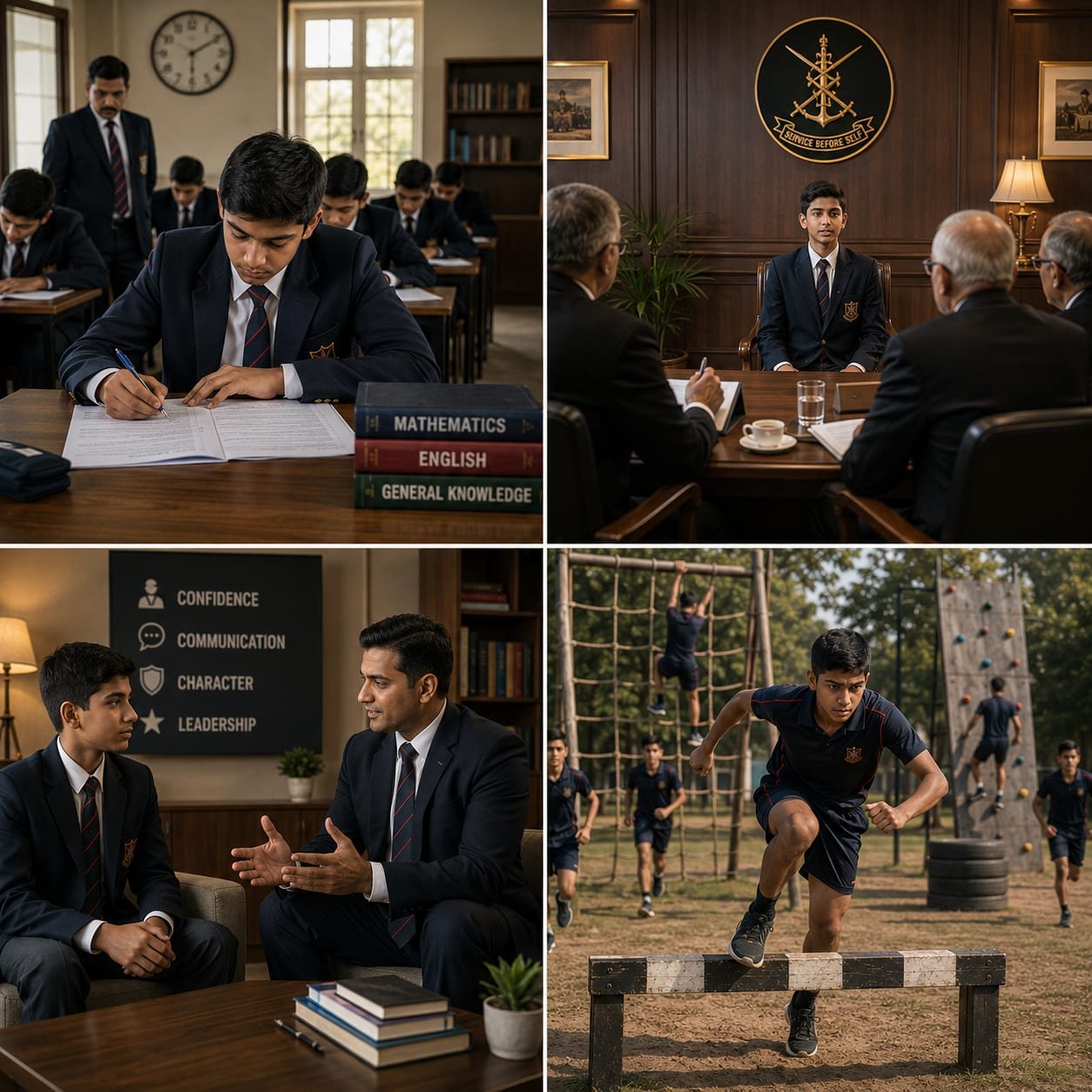
A board reads a child in four dimensions. So do we. Every hour belongs to one of the four. Every monthly report scores all four.
I
Pillar I · Written Examination
Mathematics, English & GK
Concepts first. Then speed. Maths is rebuilt from fractions upward — these papers punish gaps, not ignorance. English is comprehension and precise writing, not grammar drills. GK is a year-long habit, never a month of cramming. Timed sectionals from month two. Full papers from month five.
Pillar II · Interview & Viva
Facing the Board
The sixty-second self-introduction. The "why do you want to join" that sinks half of all candidates. One claim, one reason, one example. And the discipline of saying "I don't know, sir" — without collapsing after. Three graded boards minimum. More for those who need them.
Pillar III · Personality Development
Bearing, Voice and Character
Posture. Eye contact. How to enter a room — and leave it. Then the harder work: opinions a child can defend, hobbies with substance, and the difference between a rehearsed answer and a true one. Officers detect the first within a minute.
Pillar IV · Physical Fitness
The 24-Week Build
Endurance, strength, flexibility — scaled to age. Medical standards flagged early: vision, weight-for-height, flat feet. Children have cleared the paper and failed the medical. That is a preventable loss.
Why families choose Samvad
What you are actually buying.
— i
Officers who selected
Mock boards run by officers who sat on real panels. Your child's first board should never be the real one.
— ii
Dehradun as a classroom
We teach in the town that holds RIMC and the IMA. Students see the gates they're preparing for. It changes how they train.
— iii
One child, one plan
A written plan per student. Nobody is quietly carried along at the batch average.
— iv
Nothing is lost
Every class, board and run lives on the app. Miss a week for exams. Pick it up cleanly, in order.
— v
Fitness taken seriously
Twenty-four structured weeks, with medical checks. Not homework we set and forget.
— vi
Parents kept informed
A written monthly report — never a vague "he's doing well." Scores. Attendance. Benchmarks. Board grades.
— vii
The full runway
RIMC opens twice a year. RMS, once. We plan the whole runway — not one exam date.
— viii
Value beyond the result
Children who clear arrive at boarding life ready. Children who don't leave with discipline, fitness and a voice. Neither year is wasted.
The Student Journey
From the first assessment to the real room.
Six stages. Eighteen months. Join later and you run the same sequence, compressed — with a mentor telling you honestly what compression costs.
Ninety minutes, before any money changes hands. A written baseline. An unscored interview. A fitness benchmark. You leave with a report naming which schools are realistic — and exactly how wide the gap is.
Stage 02 · Months 1 – 3
Foundation
Repairing what school left thin — arithmetic, reading speed, one protected hour a day. Fitness Week 1 begins. No exam pressure yet. Deliberately. Children frightened in month one rarely peak in month twelve.
Stage 03 · Months 4 – 8
Syllabus Command
Full syllabus at exam standard. Weekly timed sectionals. GK in parallel. This is the long middle — where selections are quietly decided, and where self-study families fall away.
Stage 04 · Months 6 – 12
Fitness Build-Up
Weeks 12–24. Running targets tighten; posture work begins. Medical checks reviewed with the family — so nothing surfaces for the first time at a board.
Stage 05 · Final 10 weeks
Interview Simulation
Three graded boards with retired officers — recorded, reviewed with student and parent. Between boards: rewrites, drills, and the small mechanics a nervous child forgets first — knocking, greeting, sitting, leaving.
Stage 06 · Board Day
The Real Room
Documents confirmed a week ahead. A briefing call the evening before — for the child, and for you. And on the day: a child who has done this five times, walking calmly into the sixth.
The Parent Journey
You are not a spectator. You are half the campaign.
You sign the form, drive the car, wake a child at half past five — and absorb the result. So we built a parallel track for you. Dates, documents and evidence. Not reassurance.
At enrolment
The Orientation Call
Forty-five minutes with your family's mentor. The diagnostic, line by line. The targets, agreed. The odds, stated plainly. You leave with a written plan — and one WhatsApp number that always answers.
Every month
The Progress Report
One page, first working day of the month — scores, attendance, rank, fitness, and the mentor's honest note. If something is slipping, you read it in month three. Not month nine, when it's unfixable.
After every mock board
The Recording & Score Sheet
You watch the full mock board, graded sheet beside it — bearing, clarity, awareness, honesty. Parents tell us this is when the programme stops being abstract. It's usually when the child's effort changes, too.
Two months before the form
The Documentation Checklist
Every certificate, window and specification — issued as a dated checklist, verified before submission. Families lose seats to paperwork every single year. They are the most painful losses of all.
Forty-eight hours before
The Board-Day Briefing
Travel, timings, what to carry, what to wear — and what not to say in the car. Parental anxiety is the most common thing a board smells on a candidate. Named, it becomes manageable.
After the result
The Next Decision
Selected: a boarding-readiness pack — packing, homesickness, the first term. Not selected: a frank review, the second-attempt calendar, the schools still open. Either way — a call, not a form letter.
One named mentorNever a call centre. The same person, from diagnostic to result.
Full-year cost upfrontNo mid-year upsells.
A parent orientation every termA group session on what the next twelve weeks demand at home.
The Success Roadmap
Eighteen months. Measured, not hoped for.
Everything here is countable — the only fair way to sell a year of a child's life.
0wk
Fitness Programme
0
Graded Boards, Minimum
0
GK Capsules
0+
Recorded Lessons
Phase One · Months 1 – 4
The Base
Diagnostic. Foundation repair. The daily hour. Fitness weeks 1–16. Success here is habit, not marks — sessions attended, runs logged, pages read. Own the routine by month four, and you almost never lose it.
Phase Two · Months 5 – 12
The Climb
Full syllabus at exam standard. Weekly sectionals. Ranked quizzes. First interview exposure by month eight. The target: cut-off-band scores, three attempts running.
Phase Three · Final 90 days
The Gate
Full papers under exam conditions. Three graded boards. Documents locked. Medicals cleared. Nothing new is taught here. This phase exists to make the real day feel ordinary.
Questions parents ask
The honest answers — including the inconvenient ones.
Not answered here? Ask on a call. We would rather lose an enrolment than take a family in under the wrong impression.
Two years before the entrance. For RIMC, that means Class V or VI. For RMS Class VI entry, begin in Class IV. Less than a year still helps — sharply. But the calm boards reward is produced by time, not intensity.
Is RIMC really worth it for our family?+
For some children, no — and we will say so. Twenty-five seats a term. Boarding from twelve. It suits a child drawn to a services life, comfortable away from home, who enjoys structure rather than tolerating it. If the ambition is mainly yours, a top boarding school is the better campaign. We'll run that one with you instead.
My child is shy. Will this help, or make it worse?+
Shy children often do very well — boards distrust performance. We don't turn a quiet child into a loud one. We work on volume, pace, eye contact, and having three things to say about anything. The first change most parents notice happens at the dinner table.
Offline in Dehradun or online — which should we choose?+
Near Dehradun? Offline, without hesitation — correction lands harder in a room. Outstation? Online through the year, plus the ten-day residential sprint before the window. The syllabus is identical. The correction per hour is not.
Is a 24-week fitness programme safe for a ten-year-old?+
It is built precisely for that age. No weights before fourteen. No maximal testing. Rest weeks written into the plan, not improvised. Designed with an army physical training instructor, scaled per age band — and any medical condition is cleared with your own paediatrician before Week 1.
What happens if we miss the first attempt?+
You plan for it from day one. RIMC opens twice a year; RMS, annually. After a result we review the actual score sheet and rebuild the calendar. Many selections are second attempts. A first miss is a data point — not a verdict.
What do the fees include, and what is extra?+
Fees cover classes, recordings, capsules, fitness, mock boards and mentor access. Handbooks are priced separately; digital editions come with the app. Your full-year cost is stated in writing at enrolment. No mid-year "test series" upsells. Government exam fees go from you to the institution, directly.
How much of my own time will this take?+
About two hours a week — the home routine, the monthly report, a short call. More around documentation and board windows. What we will never do is hand you a syllabus and quietly expect you to teach it. That is our job.
Begin with a diagnostic
The first conversation is free. It is also a real one.
Ninety minutes. A written baseline. An honest report. No obligation. If we can't move your child meaningfully in the time available, we'll tell you on the call — not at the end of a year.