
The Art of the Interview
Home/Our Story

Our story · Dehradun, Uttarakhand

A school for the part of the exam nobody teaches.

India assesses its children constantly — and prepares them for almost none of it. We teach what no answer key covers: think clearly, sit still, speak as yourself while someone senior decides your future.

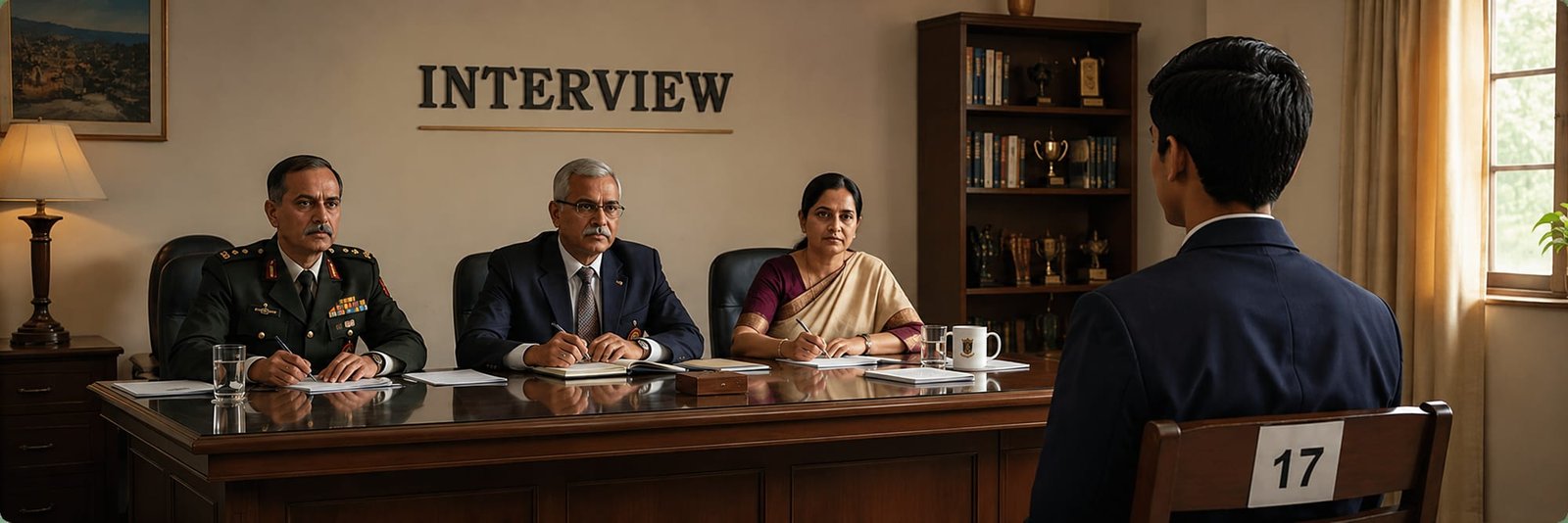
An interview board of three assessors facing a candidate

Why we exist

Merit is common in India.
Being able to show it is not.

Every year, lakhs of capable students lose seats they deserve. Not for want of ability. For fifteen unrehearsed minutes in front of a board.

A child can top a class for eight years — and still freeze when an officer asks why he wants to serve. The gap isn't intelligence. It's rehearsal, vocabulary, posture. The experience of having been questioned before.

Samvad closes that gap. Deliberately, and early. Conversation, taught as a discipline — with a syllabus, a standard, and mentors who spent their careers on the assessing side of the table.

See how we teach it
A candidate seated before an interview board?
0+
Years in Uniform
0yrs
Teaching at the IMA
0
Mentors. All in the room.
0
Students. Never more.

Why we train

Young Indians who can speak for themselves — with clarity, honesty and bearing — in the conversations that decide what comes next.

Not scripts. Not stock answers. A Samvad student can sit before any panel, in any city — and be understood exactly as they are.

The India we're building

An India where no capable child loses a seat, a commission or an offer — because nobody taught them how to be understood.

Interview readiness should be as ordinary as mathematics — and as available in Haldwani as in South Delhi.


Core values

Six things we will not trade. Whatever the season. Whatever the seat.

These are not wall posters. They decide who we hire, how we teach, and what we tell a parent when honesty costs us the sale.

— i

Integrity First

No guarantees sold. No results inflated. No borrowed personalities. Boards are trained to detect rehearsed sincerity. So are we.

— ii

Discipline as Freedom

Structure isn't the opposite of confidence. It's the source. Do the reps, and you arrive free to think — the basics no longer need thinking about.

— iii

Clarity of Thought

A muddled answer is a muddled thought. We teach students to organise ideas, not decorate them. Boards reward the first and forgive the second.

— iv

Service Before Self

Our mentors come from an institution where the team eats first. We hold students to that standard early — every board in the country is looking for it.

— v

Every Child is Different

The shy child and the loud child need opposite corrections. So we refuse to teach one method to a room. That is why batches stay at twelve.

— vi

Excellence as Habit

Results are an outcome, not a strategy. We build daily habits — reading, fitness, speech — that keep paying long after the selection letter arrives.

Teaching philosophy

We train the way the services train.
Slowly, then all at once.

Confidence cannot be lectured into anyone. It is built — by diagnosis, repetition and honest correction, in that order. Five stages. Every student. Ages ten to twenty-two.

The sequence never changes. The pace does.

Book an Assessment
Stage One

Diagnose

Nothing is taught until something is measured. A baseline across five heads — academics, awareness, articulation, fitness, temperament under questioning. Parents get it in writing. Uncomfortable parts included.

Stage Two

Build Foundations

Daily doses, not weekend marathons — comprehension, vocabulary, mathematics, current affairs. You cannot speak well about a world you haven't read. So reading is core training, not homework.

Stage Three

Rehearse Under Pressure

Mock boards at the real tempo, run by officers who sat on real ones. Unfamiliar rooms. Unhelpful silences. Questions three layers deep. The first board is meant to be hard. By the tenth, the room has lost its power.

Stage Four

Refine the Individual

Every rehearsal ends one-to-one. One student slows down. Another stops apologising. A third stops reciting. Corrections are specific, written and few — a child given ten instructions remembers none.

Stage Five

Sustain the Habit

Preparation that ends with the result was never education. We hand over habits that survive the exam — reading, fitness, a way of framing an answer that still works in a job interview a decade on.

Our approach

Six commitments. Every batch. No exceptions.

A method is only as good as its conditions. These are ours — and why we hold them.

01

Small Batches

Twelve to a batch. No exceptions for a good season. Below twelve, every child speaks in every session. Above it, the quiet ones learn to hide.

02

Assessment-Led Feedback

Every board ends in a written debrief against a fixed rubric. Improvement you can see as evidence — not encouragement.

03

Parent Involvement

Monthly checkpoints in plain language. What to say at home — and what to leave alone. A selection is a family campaign. Families deserve a map.

04

Physical and Mental Conditioning

Twenty-four graded weeks of fitness, alongside the academics. Boards read bearing before they hear answers. A trained body carries itself differently.

05

Written and Spoken, Taught as One

The paper and the interview draw on the same reading, reasoning and vocabulary. We refuse to teach them in separate rooms.

06

Alumni Mentorship

Students who cleared the gate come back for those still preparing. A cadet two years ahead persuades better than an officer thirty years ahead.

What makes us different

The honest comparison with conventional coaching.

Nothing against coaching centres. We built Samvad to do a different job — and the differences are specific enough to check.

Conventional · a hall of sixty

Twelve students. That is the batch.

In a room of sixty, a hesitant child can go a whole term without speaking — and still be marked present. At twelve, every student is questioned, corrected and heard. Every session.

Conventional · interview month

Interview training begins in week one.

Most centres teach the syllabus for eleven months and the interview for one. Composure is a slow-built habit. It cannot be installed in a crash course.

Conventional · taught by those who cleared it

Taught by those who conducted it.

Clearing tells you what you did. Sitting on the board tells you what the panel saw.

Conventional · photocopied notes

Handbooks written and revised in-house.

RIMC, RMS, GK and fitness manuals — authored by our faculty, updated every cycle. Not reprinted from material older than the exam pattern.

Conventional · the student is the client

The family is the unit of preparation.

Parents get the assessment, the plan and the honest verdict — even when the verdict is "a different school". A campaign run in the dark by one ten-year-old is not a campaign.

Conventional · fitness is somebody else's job

Bearing is taught, not assumed.

Twenty-four weeks of graded conditioning, to service standards, tracked weekly. The first things a board notices are the last things a syllabus mentions.

Leadership

The people who will actually be in the room.

Deliberately small. Deliberately senior. These are not advisors on a letterhead. They teach. They assess. They take your calls.

Sena MedalCol Amardeep Singh, SM (Retd.)

Col Amardeep Singh, SM (Retd.)

Co-Founder & Mentor

NDA. Infantry, 1993 batch. Twenty-five years in uniform — Kupwara, Siachen, Nagrota, a UN mission in Africa. Commanded his battalion in Manipur. Awarded the Sena Medal. Eight years teaching at the IMA and the Army War College. TEDx speaker. Author of five books.

Indian NavyCdr Nitin Manocha (Retd.)

Cdr Nitin Manocha (Retd.)

Co-Founder & Director

Sixteen years in the Indian Navy — naval aviation and defence aerospace — then Deputy General Manager at Adani Defence & Aerospace: the exact journey Samvad prepares students to make. M.Tech from IISc Bengaluru, M.Tech from CUSAT (gold medal), and the Defence General Management Programme at IIM Lucknow (silver medal). He has trained, mentored and evaluated over two hundred officers.

AdvocateAdv Simran Kaur

Adv Simran Kaur

Chief Coordinator

She runs the academic and student-support ecosystem, working with students, parents, faculty and mentors so every interaction holds Samvad’s standard of care and discipline. From the admission process to classes, assessments, feedback and progress — every learner supported on time, every parent kept informed.

Indian ArmyMaj Payodhi Chaturvedi (Retd.)

Maj Payodhi Chaturvedi (Retd.)

Head · Executive Communication

A decade in the Army Ordnance Corps. A Master’s in Counselling Psychology, an MBA from IIFT, and a Diploma in Defence & Strategic Management. She teaches executive presence, professional etiquette, emotional intelligence and interview excellence — application-driven, never theoretical.

Ph.D. · JNUDr. Eshita Tripathi

Dr. Eshita Tripathi

Academic Administrator & Researcher

Ph.D. in Population Studies, JNU. A researcher by training, presented nationally and internationally. At Samvad she runs academic operations — and applies research discipline to one question: is the teaching working?

What you can verify

Claims we are happy to be held to.

Veteran-led facultyArmy and Navy officers, on the boards themselves
Dehradun campusMinutes from the IMA and RIMC
Handbooks authored in-houseRIMC, RMS, GK, fitness
Progress in writingA checkpoint every month
With WEDABoarding schools, SSB, graduate readiness

Begin the dialogue

Come and meet us before you decide anything.

The first conversation is an assessment, not a sales call. Where your child stands. Which gate fits. How long it honestly takes. And if Samvad isn't the right fit — we'll say so.

Dehradun, UttarakhandOffline batches and mock boards on campus
connect@samvadinterview.comReplies within one working day
+91 89797 10976Monday to Saturday, 9:00 to 19:00 IST